
Physical therapy for the eyes and brain.
Some vision problems can't be fixed with glasses, contacts, or patching. When the eyes don't team, track, or focus properly, the fix is training the visual system itself — and that's what we've done here since 1957.
Your child can be "20/20" and still have a vision problem.
20/20 only means seeing clearly at distance. Vision is the whole system: aiming both eyes at the same point, tracking a line of print, shifting focus, and turning what the eyes take in into meaning. When any of those skills is weak, reading gets slow, homework hurts, and a bright child starts to believe they're not smart.
Vision therapy is an individualized, doctor-supervised program that trains eye alignment, eye teaming, tracking, focusing, and visual processing — using therapeutic lenses, prisms, filters, and specialized equipment. In the final phases, the new skills are made automatic so they hold for life.
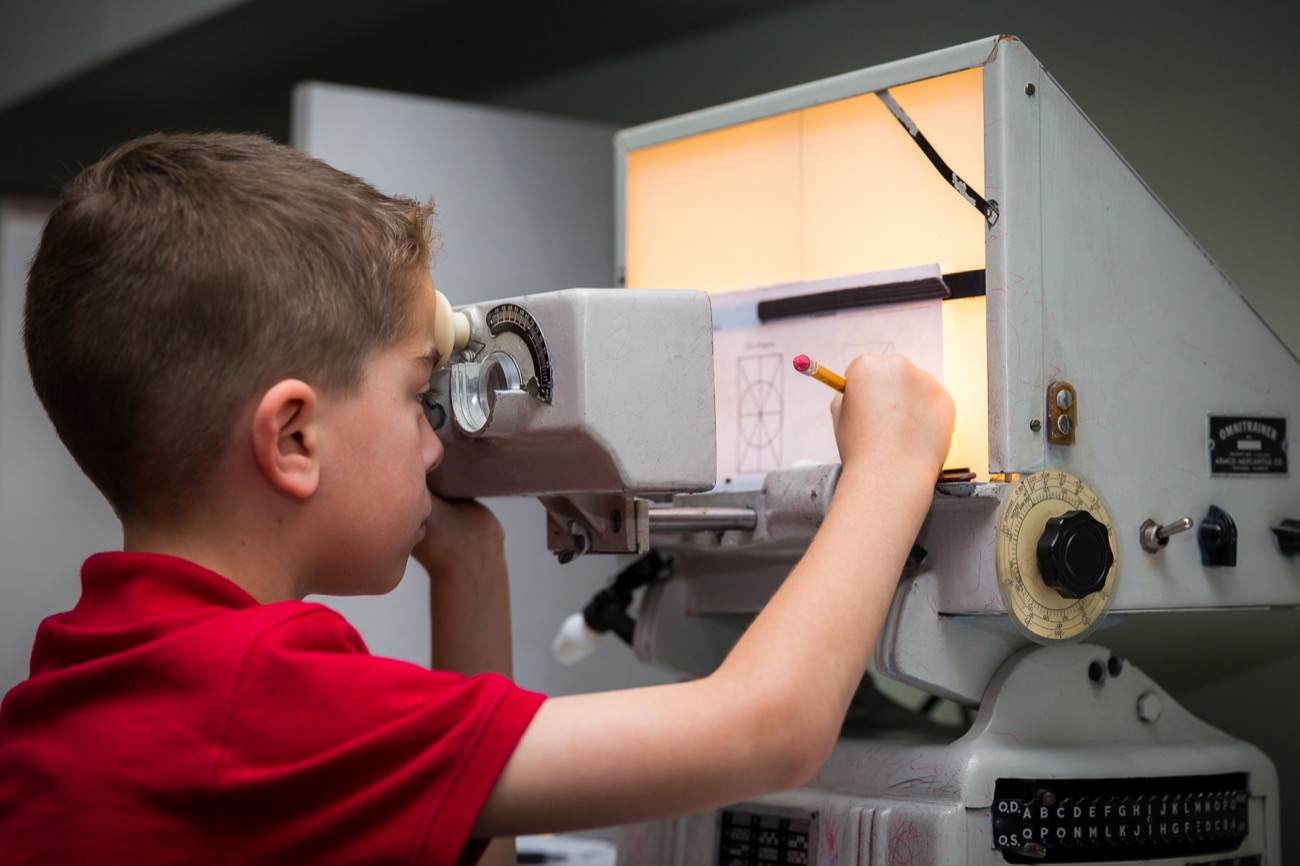
The conditions we treat every day.
Learning-related vision problems
Weak eye movement, focusing, convergence, and visual memory skills undermine reading, writing, and learning — and are often mistaken for ADHD or dyslexia.
Convergence insufficiency
The eyes don't turn inward properly for near work, so print blurs, doubles, or "swims." The most-studied condition in vision therapy — see the research below.
Strabismus & amblyopia
Eye turns and lazy eye respond to structured therapy at far higher cure rates than surgery, glasses, or patching alone — in children and adults.
Poor binocular coordination
When the two eyes won't work as a team, reading, sports, depth perception, and even eye contact suffer. Therapy builds that teamwork.
Concussion, TBI & neuro rehab
Head injury, stroke, whiplash, and developmental conditions can disrupt vision — including double vision. Rehabilitation restores visual function.
Eyestrain, screens & sports vision
Computer vision syndrome from modern screen life, and the eye-hand speed, tracking, and peripheral awareness athletes rely on — both trainable.
Backed by NIH-funded research.
The landmark Convergence Insufficiency Treatment Trial — funded by the National Eye Institute and run across major clinical centers including the Mayo Clinic — found that in-office vision therapy was the most effective treatment studied for convergence insufficiency in children, outperforming home-based exercises and placebo.
Read the randomized trial (Archives of Ophthalmology, 2008) →
View the trial registration at ClinicalTrials.gov →
In-office, hands-on, and measured at every phase.
2–3 hrs / week
In-office sessions with doctors and certified therapists — we put the emphasis on trained therapy, not worksheets at home.
7–12 months
Typical program length depending on severity, with integration breaks built in so gains become permanent.
Progress checks
Roughly 3–4 formal evaluations during the program measure exactly what's improving.
15–18 weeks
When most families notice performance improving — many see it sooner.
What makes our program different: our doctors perform hands-on therapy themselves, alongside a deep bench of trained therapists — the only program in the region built that way.