
Refer a patient to Walesby Vision Center.
When a patient isn't responding to intervention and the symptoms look visual, we're the region's referral destination for binocular vision care — treating roughly 40 therapy patients a day across two offices, with reports back to you at evaluation and graduation.
When to think "binocular vision."
Pediatricians & family medicine
Reading below grade level despite intervention · recurring headaches with near work · ADHD-pattern symptoms that don't fully respond to treatment · motion sickness · passed a screening but complaints persist. Over half of ADHD and binocular-vision symptoms overlap — a binocular workup rules the visual cause in or out.
OT / PT / speech & ABA providers
Poor visual-motor integration · clumsiness and poor judgment of distance · head tilt or eye-covering during table work · fatigue and avoidance in near tasks · plateaued progress where a visual component is suspected. We coordinate care with your treatment plan.
Educators & psychologists
Letter reversals past the expected age · loses place, skips small words, rereads lines · strong verbally but can't get it on paper · comprehension collapses after short reading periods · testing accommodations that never quite solve it. Many "dyslexia" presentations are treatable visual dysfunctions.
Optometrists & ophthalmologists
Convergence insufficiency · amblyopia and strabismus (pre/post-surgical) · persistent diplopia · post-concussion visual syndrome · patients needing in-office therapy your practice doesn't provide. Your patient returns to you for all primary care.
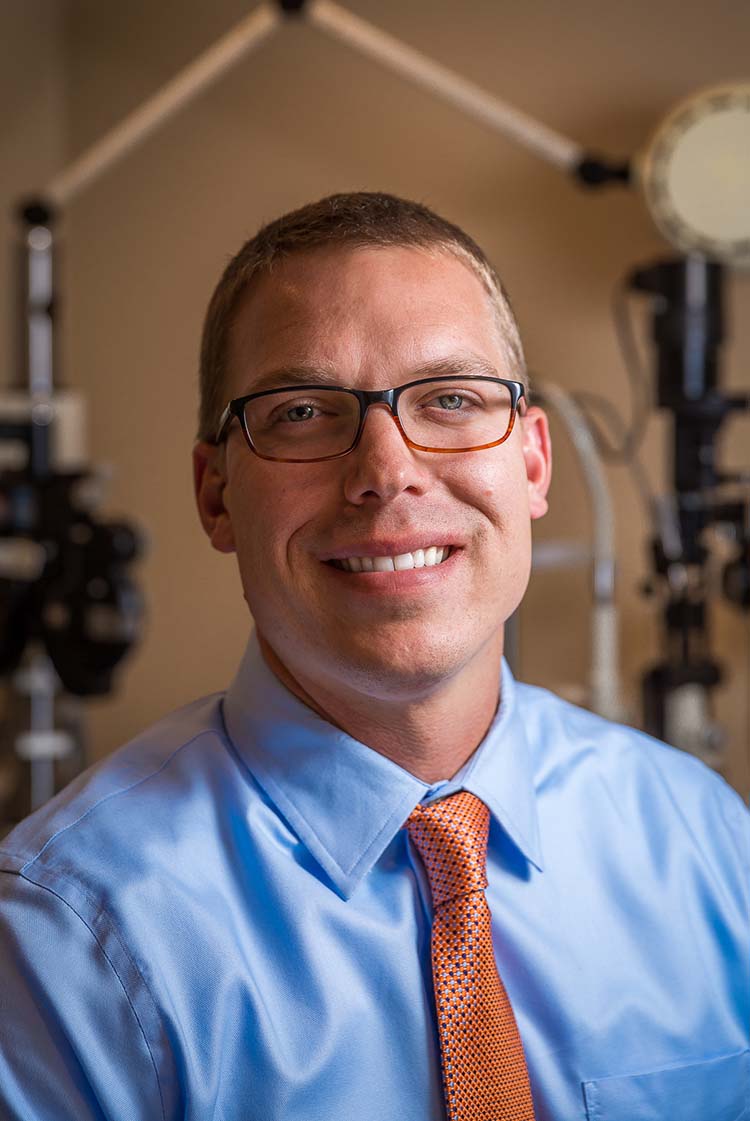
Nicholas Thomas, O.D., F.C.O.V.D.
Fellowship-trained, board-certified Behavioral Optometrist and Clinical Director of Vision Therapy. Doctor of Optometry, Indiana University (2007); Fellow of the College of Optometrists in Vision Development (2011). Dr. Thomas has worked exclusively in the diagnosis and treatment of binocular vision anomalies since 2007 and manages approximately 40 therapy patients daily.
The practice has treated binocular vision dysfunction continuously since 1957 — and it's the only program in the region where doctors perform hands-on therapy themselves.
How to refer
- Call either office — Lutz (813) 345-8544 or Oldsmar (813) 915-0755 — or fax to (813) 406-4424.
- Or send the referral online via the professional referral form — patient name, guardian contact, and the concern is all we need.
- We evaluate and report back. You receive the evaluation findings and a graduation summary when therapy completes.
Want referral pads or packet materials for your office? Call and we'll get them to you.
In-office therapy is the studied standard for CI.
The NIH-funded Convergence Insufficiency Treatment Trial found office-based vision therapy the most effective studied treatment for convergence insufficiency in children: randomized trial, Archives of Ophthalmology 2008 · trial registration.
A quick screening tool for your patients or their parents: our 30-question symptom pre-screen — the same Quality-of-Life instrument we use in office, scored instantly.